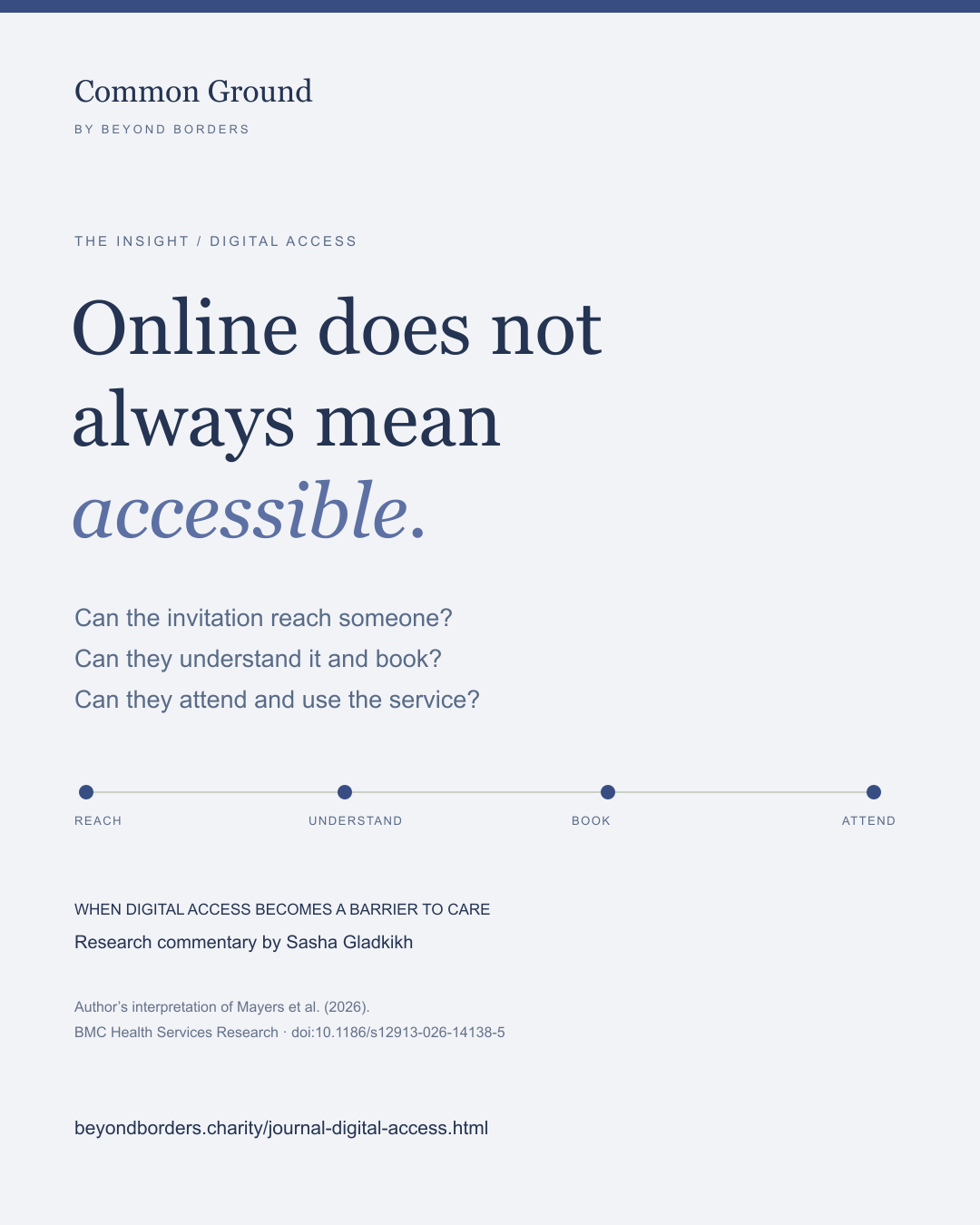
Offering appointments online does not tell us whether someone can book one, understand the instructions, or attend. To understand access, we need to follow the whole journey.
The article in 30 seconds
Three ideas to take away.
- Availability is only the beginning.A service must be usable at every step.
- Read the evidence in context.A recent publication can draw on older research.
- Test a specific improvement.Ask which change helps people complete a step.
Author’s synthesis and interpretation
01 / The finding
What the review examined
Mayers and colleagues’ February 2026 overview in BMC Health Services Research synthesized nine systematic reviews of pandemic-era healthcare access among refugee, immigrant, and migrant populations. Searches ended in July 2024. The included reviews were published in 2021–2024 and contained 14–256 primary studies each.[1]
4 high4 moderate1 critically low
Each square represents one review, grouped by methodological quality. Numbers indicate count, not study identity. Source: Mayers et al.[1]
What does “methodological quality” mean?
It describes how rigorously a review was conducted. These categories are the source authors’ AMSTAR 2 assessments; they do not measure the size of an intervention’s benefit. A high-quality review can still describe uncertain or incomplete evidence.
The authors identified both digital exclusion and useful telehealth adaptations, alongside financial, legal, communication, and trust-related barriers. This was a narrative synthesis, not a pooled estimate of intervention effectiveness.[1]
02 / The open question
Where does access break down?
Author’s interpretation
To understand access, look at what happens between steps. People need to receive the invitation, understand it, complete a booking, and attend care that meets their communication and access needs. Counting only invitations or attendance can hide where people encounter barriers.
Consider two services with identical appointment capacity. One requires an English-language account and repeated identity verification. The other offers assisted booking and a telephone route. Counting available appointments alone would miss those differences. This is an illustrative comparison, not a result from the reviewed studies.
Explore the idea
Where can access break down?
An illustrative framework, not measured results. Select a step.
Did the invitation reach the person?
An online notice may never reach someone who does not use that platform.
What to examine
Compare outreach channels and ask how participants first heard about the service.
03 / The implication
What should we test next?
The following are proposed research questions, rather than demonstrated effects:
- Does assisted booking improve completion? Compare an optional navigator-supported route with usual booking. Define the outcome as a completed appointment, and record why people choose each route.
- Where do people encounter barriers? Examine invitation, attempted booking, confirmed booking, and attendance separately. Report the number who reach each stage and clearly define the group used to calculate each completion rate. Distinguish cancellations from unsuccessful contact.
- Who benefits from an alternative route? With appropriate consent, examine differences by preferred language and access needs. Include people who never use the portal, so the evaluation does not begin by excluding those facing the greatest difficulty.
Any local study would need partner involvement, appropriate ethics review, a plan to minimize data collection, and measures chosen with community members. A small feasibility study could establish whether the process is usable before making claims about health outcomes.
What this evidence cannot establish
The review’s English-language restriction, mixed populations, variable quality, and possible overlap of primary studies limit interpretation. Its counts are not counts of unique participants or a refugee-specific effect estimate. Although the review was published in 2026, its searches ended in July 2024. It cannot establish the benefit of a particular local navigation program.[1]
The practical next step is a testable service-design question: which change helps people complete a step they previously could not? Answering that carefully would be more informative than treating a new digital platform as proof of improved access.
Reference & editorial note
1. Mayers T, Terunuma Y, Inokuchi R, et al. Barriers and facilitators to healthcare access for refugee, immigrant, and migrant populations during the COVID-19 pandemic: an overview of reviews. BMC Health Services Research. 2026;26:363. doi:10.1186/s12913-026-14138-5
This article is a focused commentary on one published review, not a new systematic review or original research. The interpretation and proposed questions are the author’s; no Beyond Borders intervention outcomes are reported.